Heidelberg's Sewer Problem Is a Clay Pipe Problem
Heidelberg was built out heavily from the 1940s through the 1960s, and the sewer infrastructure laid during that period was almost entirely vitrified clay pipe. At the time, clay was the best material available — dense, chemically stable, and reasonably durable. Seventy years later, it's a different story.
Clay sewer pipes in Heidelberg have reached or passed their design life. They crack along joints, get infiltrated by mature tree roots from the suburb's well-established gardens, and occasionally collapse entirely. When a clay pipe fails, it needs to be excavated and the damaged section replaced with modern PVC — a process we do repeatedly in this suburb.
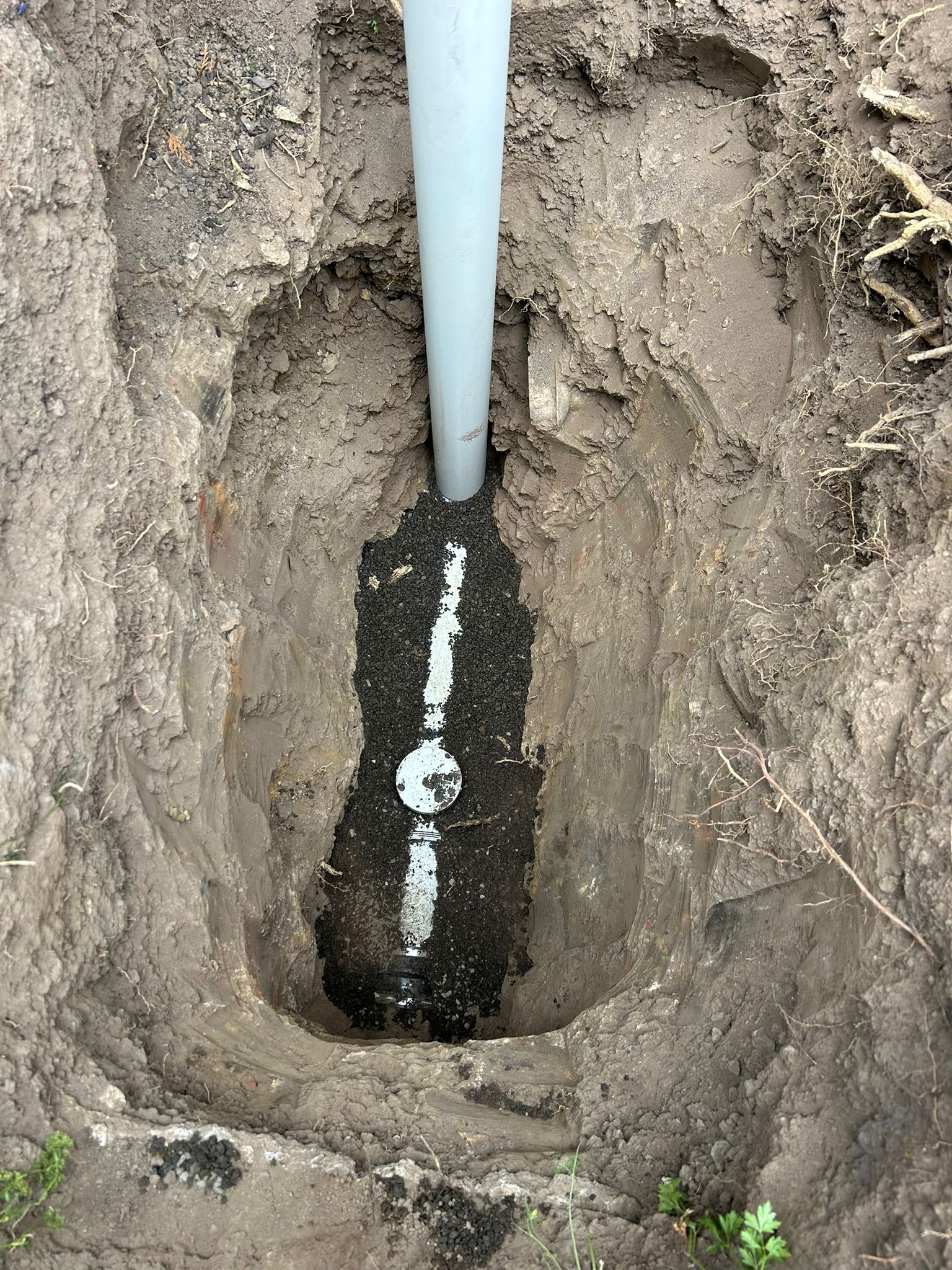
The Transition Point — Where Old Clay Meets New PVC
The photo above shows exactly what this repair looks like underground: new grey PVC pipe dropping into an excavated pit where an old dark pipe is visible at the bottom. The transition between old and new is the critical moment in the repair. If it's not sealed correctly, the join becomes a new entry point for roots and groundwater.
We use purpose-built rubber coupling sleeves with stainless steel clamps to make the clay-to-PVC connection. These fittings are flexible enough to accommodate minor pipe movement, watertight enough to pass inspection, and won't corrode. The joint is the most important part of the job — getting the pipe diameter right, ensuring no offset in the flow line, and confirming the transition is fully supported before backfilling.
Heidelberg properties are in Yarra Valley Water's service area. Sewer pipes within the property boundary are the owner's responsibility. Work on the sewer must be carried out by a licensed plumber and notified to Yarra Valley Water where required.
Old Clay vs New PVC — What You're Dealing With
- Joints rely on compression seals or lead caulking from the 1950s–60s
- Prone to root intrusion at every joint
- Brittle — can fracture from ground movement or pressure
- Scale and grease build up faster on rough interior
- Difficult to camera — dark, oval over time, joints offset
- Rubber ring-jointed fittings that flex with ground movement
- Smooth bore — waste flows freely, less grease adhesion
- Root-resistant at joints when properly sealed
- Camera-inspectable at any time — clear and straight
- 50+ year design life from installation
How We Find the Exact Failure Point
We don't excavate blind. Before we dig, we run a CCTV drain camera through the sewer line to locate precisely where the pipe is damaged — a crack, a root ball, a belly (sagging section), or a collapsed section. The camera footage tells us the fault depth and distance from the cleanout, so when we open the ground, we're digging in exactly the right place.
Targeted excavation means a smaller trench, less disruption to the yard, and faster reinstatement. We've done enough of these jobs in Heidelberg to know how the pipework tends to run and what we're likely to find.
What Happens If You Leave a Failing Clay Sewer
- Repeated blockages that jet-clearing only temporarily solves — the roots grow back
- Sewage leaching into the soil around the failed pipe — a health hazard and potential contamination of groundwater
- Sewer gases escaping through cracks and appearing inside the building
- Progressive collapse — a partial failure becomes a full collapse, which is a bigger, more expensive repair
- Slow drains that get worse over time until the line backs up completely
Recurring Sewer Blockages in Heidelberg?
If jetting the drain keeps coming back, the pipe is likely the problem. We'll camera it and give you a fixed-price repair scope before we touch anything.