The Three Ways a Sewer Problem Gets Fixed
When a Melbourne plumber diagnoses a sewer problem, there are broadly three ways it can be addressed, and they are not interchangeable. Which method is appropriate depends entirely on what the camera shows underground — not on what the plumber prefers or what's quickest.
- High-pressure jet cleaning: A high-pressure water nozzle clears blockages — grease, root mass, scale, debris. This clears the obstruction but doesn't repair damaged pipe. If the pipe itself is cracked or collapsed, the blockage returns.
- Pipe relining: A resin liner is inserted into the existing pipe and inflated, curing in place to form a new inner pipe within the old one. Works for cracked, root-infiltrated, or mildly deformed pipe — but only if the pipe still has enough structural integrity to hold the liner, and if the damage isn't a complete collapse or offset joint.
- Excavation and replacement: The ground is opened, the damaged section is physically removed and replaced with new PVC. The only option when the pipe is collapsed, when there's a major offset or bellied section, or when the connection point itself has failed structurally.
When Excavation Is Actually Necessary
A plumber who has run a CCTV camera through your sewer will be able to show you exactly what's there. Excavation is the appropriate response in these situations:
- Complete pipe collapse — the pipe has caved in and flow has stopped entirely
- Major offset joint — ground movement has shifted two pipe sections out of alignment, creating a step that catches waste
- Severely bellied section — a section of pipe has sunk, creating a low point that permanently pools with water and waste
- Structural failure at a connection point — the brick or clay junction where your property connects to the main sewer has deteriorated
- Root intrusion so severe the pipe has been deformed — roots can physically change the pipe's cross-section over decades
- Multiple failed sections too close together for relining to be cost-effective
- Root intrusion at joints in otherwise sound pipe — jetting clears, relining prevents recurrence
- Hairline cracks or minor joint gaps without offset — relining seals these
- Grease or scale blockage with no structural damage — jetting resolves
- Surface sag (bellying) of 50mm or less where structural integrity is maintained — relining can bridge this
- Blockage caused by foreign objects (wipes, rags, toys) — jetting or rod clears this
A reputable plumber will camera the drain before recommending excavation. If you're being quoted excavation work without a camera inspection having been done first, ask why. The camera footage should be viewable and should clearly show the fault being cited as the reason for digging.
What to Expect During a Sewer Excavation in Melbourne
If excavation is the right call, here's what the process actually looks like in a typical Melbourne home context:
- Dial Before You Dig: We are legally required to check for underground services before any excavation. Power, gas, water and telecoms are all mapped through DBYD and confirmed before the first shovel goes in.
- Mechanical and hand excavation: Depending on access and depth, excavation may use a small machine (for open yard access) or hand tools (for tight side-path or enclosed areas). Most residential sewer repairs in Melbourne are hand-dug to avoid damaging surrounding pipes and services.
- Shoring: At depths below 1.5m, or at shallower depths in unstable soil, shoring is required. This means the trench walls are supported to prevent collapse.
- Pipe work: The damaged section is cut out and replaced with new PVC using appropriate couplings. The new pipe is bedded on compacted sand and set to the correct gradient.
- Backfill: The trench is filled in layers, each compacted, to prevent future settlement. Poorly compacted backfill causes the ground surface to sink over time — a problem on concrete paths especially.
- Reinstatement: Concrete, pavers, or garden beds are reinstated as closely as possible to the original condition.
Shoring and Safety — What to Look For
Under WorkSafe Victoria regulations, any excavation over 1.5 metres deep requires a shoring system before anyone enters. This is not optional and is not a sign that a job is being over-engineered — it's a legal requirement that prevents trench collapse, which can be fatal.
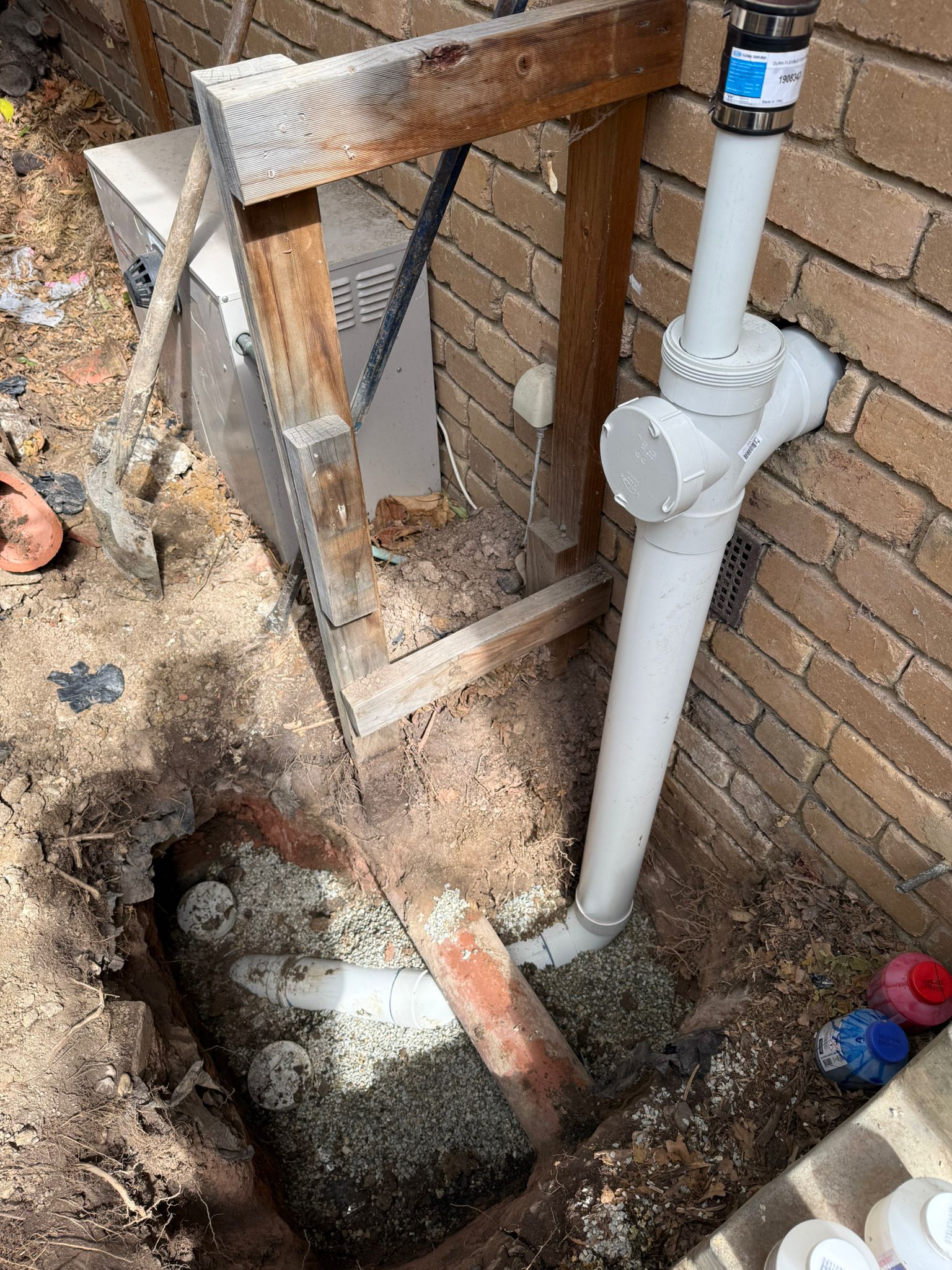
Timber shoring (as visible in the photo above), steel trench boxes, or hydraulic shoring systems are all compliant methods. If you're watching a plumber work in a trench deeper than knee height with no wall support, that's a red flag. Any reputable plumber complies with WorkSafe requirements — ask if you're unsure.
What Affects the Cost of a Sewer Excavation
Sewer excavation in Melbourne varies significantly in cost depending on several real factors — not just the length of pipe replaced. Understanding these helps you evaluate a quote properly:
- Depth: Deeper excavations take longer to dig, require more substantial shoring, and take longer to backfill. A 600mm-deep repair is much faster than a 1.5m repair.
- Access: A side path 700mm wide is harder to work in than an open back yard. Tight access means hand digging and slower progress.
- Surface type: Excavating through a garden is quicker and cheaper than cutting through a concrete driveway or tiled patio. Concrete cutting and reinstatement adds cost.
- Proximity to services: Excavating near gas or water mains requires hand digging and slower progress for safety.
- Length of repair: Obviously — a 1-metre section costs less than a 4-metre section.
A proper sewer excavation quote should be fixed-price after camera inspection — not "time and materials." Time-and-materials billing on excavation work is difficult to manage and can escalate beyond what the job warrants. We quote fixed-price after camera inspection for every sewer repair.
Not Sure What Your Sewer Actually Needs?
We'll camera it and tell you exactly what's there — and whether excavation is the right answer or not. No pressure to proceed.